
How long does it take to recover from jet lag and travel fatigue? Most travelers recover within 3-7 days, with jet lag typically requiring about one day of recovery per time zone crossed, according to CDC and Sleep Foundation guidelines. However, recovery time varies significantly based on your travel direction, age, and how quickly you implement research-backed recovery strategies.
Recognizing Travel Exhaustion
You’ve just landed after a long flight. Instead of feeling energized, you’re dealing with exhaustion, brain fog, disrupted sleep, or irritability. This is travel exhaustion, a combination of jet lag (a circadian rhythm disorder), physical fatigue from the journey itself, and sometimes travel burnout.
The good news? You don’t have to wait a week to feel normal again. Understanding why jet lag happens and applying specific recovery protocols can cut your recovery time significantly, often by 50% or more.
Prevention: The “Pre-Flight” Protocol
- The 3-Day Shift: Adjust your bedtime by 30–60 minutes each night for 3 days before departure.
- The “Strategic Stopover”: If flying 12+ hours, break the trip into two segments. A day-use hotel stay during a long layover can prevent the compounding exhaustion of ultra-long-haul travel.
- Smart Flight Selection: Aim for early evening arrivals. This forces you to stay awake for a few hours before crashing at a normal local bedtime.
5 Steps to Recover Faster
- Prioritize Quality Rest: If you cannot sleep through the night, consider a daycation to bridge the gap. Deep recovery requires an environment free from distractions.
- Stay Hydrated: Travel dehydrates the body, which worsens fatigue. Drink water and electrolytes before, during, and immediately after your flight.
- Get Timed Natural Sunlight: Sunlight is the primary cue to reset your body clock. Exposure to morning light suppresses melatonin to wake you up, while avoiding bright light in the evening helps you sleep.
- Adjust to Local Time Immediately: Try to eat and sleep according to your destination’s clock as soon as you land.
- Move Lightly: Gentle exercise boosts circulation and helps you stay awake without over-tiring your body.
Where to Recover: Why Environment Matters
For many travelers, the biggest obstacle to quality rest isn’t willpower, it’s environment. At home, you’re competing with family needs, pets, chores, and the psychological pressure to be productive. At airports, you’re dealing with noise, crowds, and uncomfortable seating.
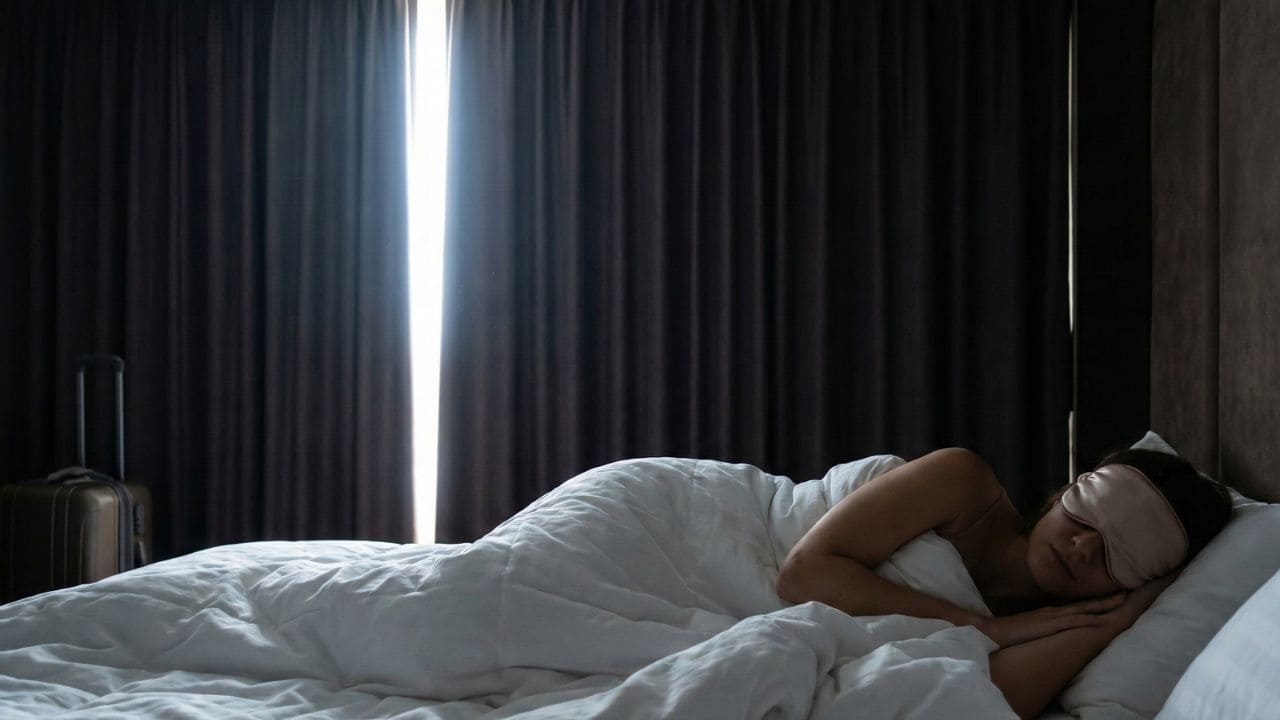
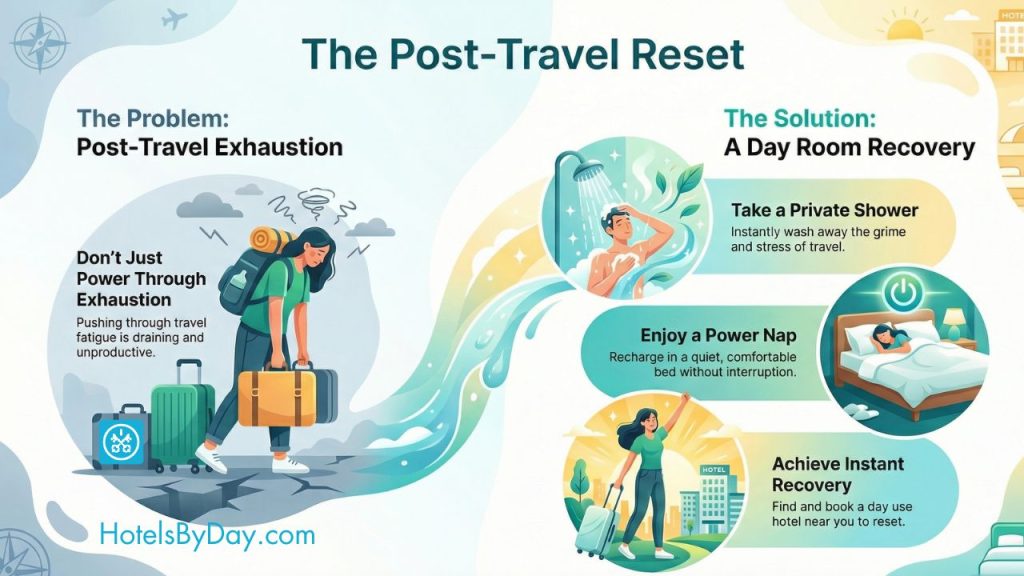
Day-use hotels (or “daycations”) have become a popular solution: you can book a room for 3-11 hours specifically for recovery—to shower, nap in complete darkness, and reset without interruption. The controlled environment (blackout curtains, temperature control, soundproofing, privacy) provides conditions that genuinely accelerate circadian adjustment, especially for travelers crossing 5+ time zones.
This isn’t essential for everyone, but if you’ve struggled to recover at home in the past or you’re facing a particularly demanding schedule upon return, a 4-6 hour hotel day stay can compress days of recovery into one focused rest period.

How Long Does Recovery Take?
The rough rule: Expect about one day of recovery for every time zone you cross. So a flight from New York to London (5 time zones) means 5 days of feeling “off.”
But here’s where it gets interesting—direction matters more than distance.
Eastward vs. Westward: Why Flying East is Harder on You
Ever notice that flying to Europe feels worse than flying back? That’s not in your head.
When you fly eastward, you’re shortening your day—asking your body to fall asleep hours before it’s ready. It’s like trying to go to bed at 4 PM. Your biology fights you every step of the way.
Flying westward extends your day, which aligns with how your body naturally works. Your internal clock actually runs slightly longer than 24 hours, so staying up a few extra hours? Your body can handle that.
| Direction | The Challenge | The Strategy |
|---|---|---|
| Eastward (e.g., US → Europe) | Shortens the day. Harder to fall asleep earlier than usual. | Seek morning light. Avoid afternoon naps to build sleep pressure. |
| Westward (e.g., Europe → US) | Lengthens the day. Harder to stay awake in the evening. | Seek evening light. Use short naps (20 mins) if struggling to stay awake. |
The Science: Why These Methods Work

Understanding the biology of jet lag helps you treat it effectively rather than just enduring it.
Light is your reset button. When sunlight hits your eyes, it signals your brain to suppress melatonin (the sleep hormone). This is why timed light exposure is the single most powerful tool for beating jet lag.
Your body prefers longer days. Your natural rhythm runs slightly longer than 24 hours, which is why westward travel (extending your day) feels easier than eastward travel (shortening it). You’re working with your biology, not against it.
Airplane air wrecks you. Cabin humidity drops to 10-20%—about half of normal indoor levels. This dehydrates you faster and contributes to brain fog and exhaustion, even on short flights.
First Day Recovery Protocol
The first day determines how the rest of your week feels. Follow this timeline immediately upon landing.
For Eastward Travel (e.g., US → Europe)
Challenge: You need to sleep earlier than your body wants to
Upon Arrival (Morning/Early Afternoon)
- Hydrate immediately and resist napping, no matter how tired you feel
- Get outside for 30-60 minutes of natural sunlight as soon as possible
Midday Through Afternoon
- Eat meals according to local times, even if you’re not hungry
- Stay active and outdoors when possible
Evening
- If you’re desperate, take a 20-minute power nap before 3 PM—but no longer
- Start winding down 1-2 hours before local bedtime
- Sleep in a cool (65-68°F), completely dark room
For Westward Travel (e.g., Europe → US)
Challenge: You need to stay awake longer than your body wants to
Upon Arrival (Usually Morning/Midday)
- Hydrate and get outside for sunlight exposure
- Resist the urge to nap early
Afternoon
- If exhaustion hits, take one 20-minute power nap maximum (not after 4 PM)
- Keep moving—take walks, run errands, stay engaged
Evening (4-8 PM)
- This is your danger zone. Get bright light exposure outdoors if possible
- Light exercise (walking, stretching) helps fight drowsiness
- Push through to at least 8-9 PM local time before sleeping
5 Common Mistakes That Prolong Jet Lag Recovery
- Taking long naps: Naps over 30 minutes can anchor you to your old schedule and make it harder to sleep at the appropriate local time.
- Staying indoors all day: Missing sunlight exposure is the #1 recovery mistake.
- Using alcohol to fall asleep: While it may help you doze off, alcohol disrupts REM sleep quality and worsens dehydration.
- Eating heavy meals at odd times: Large meals when your body thinks it’s midnight compounds digestive disruption.
- Immediately diving into intense exercise: Vigorous workouts stress an already-taxed system; stick to light movement.
Recovery Varies By Age
Younger Adults (Under 40) You’ll generally bounce back faster, often within 3-5 days. Your body can handle more aggressive adjustments, so don’t be afraid to immediately switch to local time rather than easing in gradually.
Older Adults (40+) Expect recovery to take 5-10 days, especially for long-haul flights. As sleep efficiency naturally declines with age, prioritize:
- Hydration (your #1 tool)
- Morning sunlight exposure to reinforce your circadian rhythm
- Breaking ultra-long flights (12+ hours) into segments with stopovers
Traveling with Children Kids adapt quickly thanks to flexible circadian rhythms, but watch for mood disruptions. Maintain familiar bedtime rituals (stories, comfort items, routines) even when the actual sleep time has shifted.
Jet Lag vs. Travel Burnout: Knowing the Difference
Not all travel exhaustion is the same. If light exposure and sleep schedules aren’t helping, you might be dealing with burnout rather than jet lag.
Jet Lag is a circadian rhythm disorder. Your internal clock is out of sync with your location.
→ Fix it with: Timed sunlight, strategic naps, melatonin, adjusted mealtimes
Travel Burnout is mental and emotional exhaustion from the overstimulation of travel itself.
→ Fix it with: Boundaries, quiet time, reduced sensory input
How to Treat Burnout Quickly
Unlike jet lag, you cannot “power through” burnout. Your brain needs genuine rest, not just sleep.
- The “Buffer Day” Rule: Never return to work the day after landing. Schedule 24 hours of zero commitments.
- Sensory Rest: Limit social interaction, screen time, and stimulation for 2-3 days. Give your nervous system time to downshift.
- Mental Processing: Journal about the trip to help your brain transition from “travel mode” back to normal life.
When to Seek Medical Attention
Most travel exhaustion resolves on its own, but certain symptoms need professional evaluation:
Chronic condition flare-ups: Uncontrolled diabetes, heart palpitations, or other conditions worsened by time zone changes
Persistent symptoms beyond 2 weeks: Fatigue or insomnia that won’t improve
DVT warning signs: Swelling, pain, warmth, or redness in one leg (Deep Vein Thrombosis is a serious complication of long flights)
Mental health changes: Panic attacks, severe anxiety, or depression triggered by travel
FAQ
How long does jet lag typically last?
Expect about one day of recovery per time zone crossed. A flight from New York to London (5 time zones) usually means 3-5 days of adjustment. Eastward travel takes longer than westward. According to CDC guidelines and the Sleep Foundation, most jet lag symptoms resolve in 1–7 days.
Why is flying east harder than flying west?
Eastward travel shortens your day, forcing you to sleep earlier than your body wants. Flying west extends your day, which aligns with your body’s natural rhythm (which runs slightly longer than 24 hours).
Should I nap when jet lagged?
Only if desperate, and keep it under 20 minutes before 3-4 PM local time. Longer naps anchor you to your old schedule and make nighttime sleep harder.
Does melatonin help with jet lag?
Melatonin can help, but timing matters more than the supplement itself. Take it 30 minutes before your desired bedtime in the new time zone, not your old one.
Why am I exhausted even without changing time zones?
Cabin air (10-20% humidity vs. 30-60% normal), poor sleep in cramped seats, irregular eating, and disrupted routines all contribute to travel fatigue—even on domestic flights.
What’s the difference between jet lag and travel burnout?
Jet lag is physical—your circadian rhythm is out of sync. Travel burnout is mental/emotional exhaustion from overstimulation, planning stress, and constant activity. Jet lag needs light exposure and sleep timing; burnout needs quiet time and boundaries.
