
A Miami airport layover is time between connecting flights that can range from under an hour to overnight, depending on your itinerary. Whether you’re connecting domestically or arriving internationally, Miami International Airport presents unique challenges: long walking distances, crowded terminals, and limited rest options.
This guide covers practical strategies for navigating a layover Miami, whether you’re looking to sleep Miami airport in a gate area, shower Miami airport in a lounge, or simply find a quiet corner to recharge before your next flight. We’ll walk through what’s realistic at each stage of your connection and when it makes sense to stay versus leave the terminal for day use hotels near MIA airport.
For travelers facing extended connections, knowing your options ahead of time can transform waiting time from stressful to manageable, or even restorative.
Table of Contents
- Quick Answers: MIA Layover Essentials
- What to Do by Layover Length (0–6+ Hours)
- 3 Factors to Check Before You Land
- Where to Shower (Lounges vs. Day Rooms)
- Sleeping & Napping at MIA
- Finding Quiet Spots & Work Areas
- Terminal Guide (North, Central, South)
- Should You Leave the Airport?
- International Connections & Customs
- Frequently Asked Questions
Quick Answers: Miami Airport Layover Guide
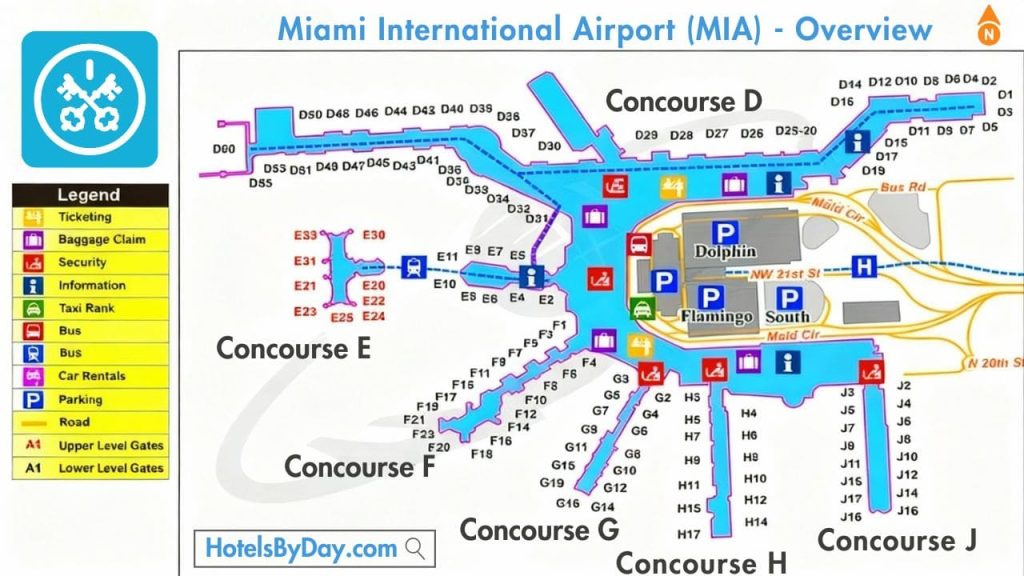
MIA layout: Miami International Airport is divided into North (Concourse D), Central (Concourses E, F, G), and South (Concourses H, J). Each terminal has different lounge options and walking distances.
Fastest way across Concourse D: Concourse D stretches about a mile end-to-end. The Skytrain runs above the concourse with four stations and trains every 2-3 minutes, cutting a 30-minute walk down to 5 minutes.
If you need a shower: The most reliable paths are lounge access (verify shower amenities first) or a nearby day use room for guaranteed privacy. Start with the official MIA lounge directory to see what exists in each concourse, then verify shower amenities directly with the lounge.
International connections: MIA lists three U.S. Immigration & Customs areas: D (Level 1), E (Level 1), J (Level 3). If you arrive at Concourse F, MIA notes a courtesy trolley to the Concourse D International Arrivals Facility.
What to Do During a Miami Airport Layover
Not all layovers are created equal. What’s realistic during a 90-minute connection differs dramatically from what you can accomplish during a 6-hour wait. This breakdown helps you match your available time to realistic goals during a layover Miami.
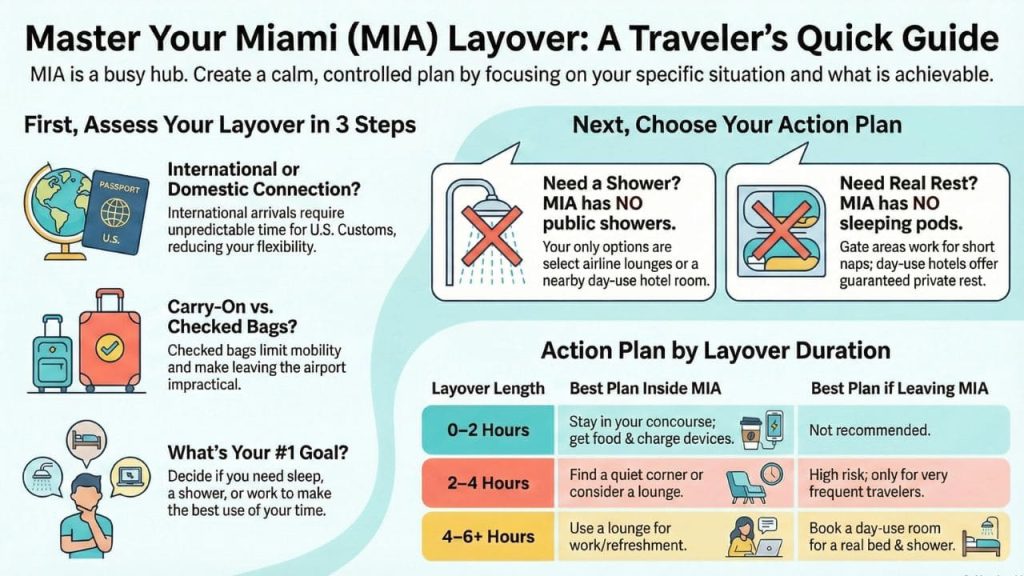
| Layover length | Best plan inside MIA | Best plan if leaving MIA | Best for |
|---|---|---|---|
| 0–2 hours | Stay in your concourse, quick food, charge devices | Usually not worth it | Tight connections |
| 2–4 hours | Find a quiet corner, quick reset routine, consider lounge if eligible | Only if you are very close and lines are light | Business guests |
| 4–6 hours | Lounge if it helps your goal (work, quiet, refresh) | Day use room if you need a real reset | Business + international connectors |
| 6+ hours | Structure your time: food + quiet + movement + rest | Day use room for sleep/shower/privacy | Anyone who needs real rest |
The key insight: shorter layovers demand you stay close to your gate, while longer connections open up options like lounge access or even stepping outside the airport for a proper reset.
Traveling with a pet? Find pet relief areas at US airports before you land.
Before Your Miami Airport Layover: 3 Key Factors
Before you commit to any plan, whether that’s booking lounge access, hunting for a spot to nap MIA, or leaving the airport entirely—three factors will determine what’s actually realistic versus what sounds good in theory.
1. Domestic vs International Connection at MIA
What changes: International connections at MIA require U.S. Immigration and Customs, which fundamentally changes your flexibility. Processing happens at three locations: Concourse D (Level 1), Concourse E (Level 1), or Concourse J (Level 3). Depending on arrival waves, staffing, and how many flights land simultaneously, you could clear in 30 minutes or wait 2+ hours.
What to verify: Check which concourse you’re arriving into and where customs processing will occur. If you’re arriving at Concourse F, note that MIA operates a courtesy trolley to the Concourse D facility, which reduces walking but not processing time.
The “play it safe” approach: Domestic connections let you stay airside, move between concourses freely, and skip re-screening. When timing feels uncertain or tight, staying inside the terminal removes the risk of missing your connection due to unpredictable customs lines.
2. Checked Bag vs Carry-On Only
How checked bags limit your options: Checked luggage changes everything during a layover Miami. After international arrivals, you’ll need to reclaim your bags, clear customs, and recheck them—adding 30-60 minutes minimum to your timeline. This makes leaving the airport impractical and even limits how freely you can move between terminals.
Switching airlines often requires picking up and rechecking bags even on domestic connections, which eats into time you’d otherwise use for rest or work.
Carry-on advantages: Carry-on-only travel removes these constraints entirely. You can reach lounges without stress, explore different concourses for quieter gate areas, or consider off-airport options like day-use hotel rooms when your layover stretches beyond 4-6 hours. You’re not anchored to baggage claim or recheck counters.
3. Your Non-Negotiable Layover Priority
Pick one: shower, sleep, work, or relax. This might sound limiting, but it’s the most practical advice for layovers at large airports like MIA where walking distances and security lines add up quickly.
Optimize for that priority: Trying to accomplish everything—showering, napping, working, and exploring dining options—usually results in rushed decisions, unnecessary stress, and disappointment when you realize you’ve spent your entire layover walking rather than resting.
If you need a shower above all else, your plan centers on lounge access or a day-use room. If sleep is the priority, you’ll focus on finding the quietest gate area or booking a room with a real bed. If you need focused work time, outlets and stable seating become your main criteria.
Once you choose your main goal, planning your Miami airport layover becomes straightforward rather than overwhelming.
Can You Shower at Miami Airport?
According to the MIA FAQ, there are no public shower facilities at Miami International Airport. If you need to shower Miami airport during your connection, you have two realistic paths: airline lounge access or a nearby day-use hotel room.
This limitation surprises many travelers, especially those connecting through MIA on long-haul international flights where a shower feels less like a luxury and more like a necessity.
Shower Options at Miami Airport
1) Airport Lounge Access for Showers
Lounge access depends on your airline status, credit card benefits, or willingness to purchase a day pass. Not all lounges offer showers, and those that do may have limited availability during peak hours or impose time restrictions.
Start with the official lounge directory to see which lounges operate in your concourse. Lounges in Concourse D include the American Airlines Flagship Lounge (D30), Admirals Clubs (D15 and D30), and the American Express Centurion Lounge (near D12). Other terminals have options like the Delta Sky Club (Concourse H) and Turkish Airlines Lounges.
2) Day Use Hotel Rooms Near MIA for Showers
Day-use hotel rooms near MIA offer the most predictable option to shower Miami airport: a private bathroom with a full shower, no time limits, and no dependency on airline status or lounge capacity restrictions. This option makes the most sense for layovers of 4-6+ hours where you want a complete reset rather than a rushed lounge experience.
Featured In-Terminal Option: Miami International Airport Hotel
If you’re at the Miami International Airport on a long layover, the Miami International Airport Hotel is located inside the airport terminal, making it the perfect day use spot to relax in privacy, get some work done, or catch up on sleep. Wandering around an airport terminal can be miserable, but there’s a solution at MIA. Thanks to the comfortable accommodations at the Miami International Airport Hotel, you’ll never need to worry about a sleepless and jetlagged layover.
Dine at the Top of the Port Restaurant for breakfast, lunch, or dinner. Take advantage of the beautiful weather and soak up the Florida sun in South Beach. The Miami International Airport Hotel is the perfect transit hotel for your daytrip to Miami.
Book your hotel day stay at the Miami International Airport Hotel with Hotels By Day today!
What to Check Before Paying for Lounge Access
Don’t assume every lounge has showers just because you have access. Before you commit:
Confirm lounge location is airside for your concourse. Some lounges require re-clearing security or significant walking, which defeats the purpose during a short layover.
Confirm access rules and capacity language in the lounge listing. Many lounges now restrict entry during peak hours, even for members or day-pass holders. The American Express Centurion Lounge at MIA has been specifically noted for overcrowding issues.
Verify shower availability with the lounge directly (amenities vary). Call ahead or check online reviews for current shower policies. Some lounges limit shower time during busy periods or require reservations.
2-Minute Refresh Kit for Layovers
When showers aren’t available or practical during your Miami airport layover, a simple refresh kit can bridge the gap:
- Face wipes (unscented work best)
- Toothbrush + mini toothpaste
- Deodorant
- Travel comb or brush
- Fresh tee or base layer
This combination takes up minimal space in a carry-on but makes a noticeable difference in how you feel before boarding your next flight.

Where Can You Sleep at Miami Airport?
The reality of trying to sleep Miami airport is this: you’ll get short, light rest rather than deep, restorative sleep. Airport terminals aren’t designed for sleep—they’re designed to move people efficiently through security and onto planes.
That said, many travelers successfully nap MIA during longer layovers by choosing the right location, bringing the right gear, and setting realistic expectations.
MIA does not have sleeping pods or dedicated nap rooms as of December 2025. Unlike airports such as Munich or Abu Dhabi that offer private sleep cabins, MIA provides only standard gate seating. This means your comfort depends entirely on finding quieter areas and managing your environment as best you can.
What to Expect from Airport Naps at MIA

Short, light rest beats trying to force deep sleep in noise and bright lighting. Airport naps typically last 20-60 minutes—long enough to reduce fatigue but not long enough to enter deep sleep stages where you might wake up groggy.
The constant background noise (announcements, foot traffic, cleaning crews) means you won’t experience the kind of restorative sleep you’d get in a hotel bed. But a 45-minute nap in a relatively quiet gate area can still improve alertness and mood significantly, especially if you’re facing another long flight.
How to Make Airport Naps More Comfortable
These items transform uncomfortable gate seating into a workable nap setup when you’re trying to sleep Miami airport:
Layers (terminal temps vary): MIA terminals can feel surprisingly cool, especially in the evening. A light jacket or sweater serves double duty as warmth and makeshift pillow.
Eye mask: Blocks terminal lighting that stays bright 24/7. Even during overnight layovers, MIA doesn’t dim lights significantly.
Earplugs: Reduces but doesn’t eliminate announcement noise. Foam earplugs work better than earbuds for actual sleep when you nap MIA.
Phone low-power mode + alarm: Set your alarm for 20-30 minutes before you need to be at your gate, not when boarding starts. Enable low-power mode so your alarm will sound even if your battery drains.
Keep bags anchored: Loop a strap through your chair leg or arm or use your bag as a pillow with your arm through the strap. This prevents theft and lets you relax without constant vigilance.
For more strategies on making the most of extended connections, see our guide to surviving a long layover.
When to Book a Day Use Room Instead
If you need uninterrupted sleep, real privacy, or a reliable reset window—especially for layovers of 6+ hours—trying to nap MIA in a gate area often feels more frustrating than restful.
A day use room near MIA provides what the airport can’t: a proper bed with pillows and blankets, a private bathroom with a shower, temperature control, complete darkness, and guaranteed quiet. You’ll pay for the convenience, but many travelers find that arriving at their destination actually rested is worth the cost.
This is particularly valuable if you’re traveling for business and have meetings or presentations upon arrival, or if you’re facing a long-haul flight where starting exhausted makes the journey significantly harder.
Learn more about how day use hotels work and why they’ve become popular with travelers who need more than what airport facilities can reliably provide.
Need a real reset during your layover?
Book a HotelsByDay day room for a shower, nap, and quiet time.
See day-use hotels near MIAWhere to Find Quiet Places at Miami Airport
Finding a quiet spot during your Miami airport layover can transform dead time into productive work hours or genuinely peaceful rest. MIA has pockets of calm if you know what to look for and where to search.
The challenge: MIA is a busy hub serving millions of passengers annually. True silence doesn’t exist. But relative quiet—spaces where announcements fade, foot traffic thins, and you can actually think—is achievable with the right strategy.
What to Look for in a Quiet Layover Spot
Rather than wandering aimlessly and hoping to stumble upon a good spot, target these specific features:
Outlets nearby: Power access keeps devices charged for work or entertainment without forcing you to abandon your spot to hunt for charging stations. Gate areas near walls typically have more outlet availability than center seating.
Lower foot traffic: End-of-concourse gates work best, particularly gates serving smaller aircraft or less frequent departures. Upper levels in some terminals also see less foot traffic than main concourses. Avoid gates near food courts or main walkways.
Seating with back support: Padded chairs with armrests and back support matter significantly during multi-hour waits. The difference between upright seating and reclined seating affects whether you’ll be able to rest meaningfully or just kill time uncomfortably.
Minimal announcements: Some sections of MIA have fewer overhead speakers or are positioned away from the main announcement zones. Gates at the far ends of concourses often experience this benefit.
Business Traveler Reset Plan (45-90 Minutes)
For business travelers who need to stay sharp between flights during a layover Miami, this structured approach balances productivity with physical recovery:
1) Hydrate and snack (10 minutes): Start with water and protein-focused snacks rather than caffeine and sugar, which cause energy crashes. Your brain functions better hydrated.
2) 20-minute work sprint: Tackle one focused task—review presentation slides, respond to critical emails, or outline your next meeting agenda. Set a timer. Short, focused bursts are more effective than scattered multitasking.
3) 10-minute walk: Move through the concourse at a moderate pace. This improves circulation after sitting on your previous flight and prevents stiffness before your next one.
4) 10-minute quiet reset: Find a spot away from foot traffic. Close your eyes, practice deep breathing, or simply let your mind rest without screens.
5) Re-check gate and timing: Confirm your gate hasn’t changed and you know exactly how long it takes to reach it from your current location. This prevents last-minute rushing.
This routine takes 60 minutes total but leaves you feeling more alert and less drained than sitting passively for the same period.
Miami Airport Terminal Guide for Layovers
Miami International Airport is divided into three distinct terminals, each with different layouts, passenger volumes, and amenity mixes. Understanding which terminal you’re in—and what that means for your layover options—helps you plan your airport layover more effectively.
The terminals aren’t interchangeable. What works in compact Central Terminal might not translate to sprawling Concourse D. Here’s what each offers and how to navigate them strategically.
Unlock your day in a few taps
Book your day stay even faster with our iOS and Android apps!


North Terminal (Concourse D) Layover Guide
Best for: Long concourse navigation and multiple lounge options
Concourse D is MIA’s longest terminal at roughly one mile end-to-end, serving primarily American Airlines flights along with some international carriers. This length presents both challenge and opportunity: more walking means more effort, but it also means more gates spread out over more space, creating pockets of relative calm at the far ends.
How to Get Around Concourse D
Walking the full length of Concourse D takes 20-30 minutes depending on your pace and how crowded the walkways are. For most travelers, especially during tight connections or when already fatigued, this isn’t realistic.
The Skytrain solves this problem. It runs above the concourse with four stations positioned roughly every quarter mile. Trains arrive every 2-3 minutes during operating hours (5 a.m. to midnight) and complete the full route in about 5 minutes.
The four stations are:
- Station 1 (D1-D19): Near the concourse entrance
- Station 2 (D20-D25): Mid-concourse
- Station 3 (D26-D39): Mid-to-far section
- Station 4 (D40-D60): Far end of concourse
Separate lobbies handle domestic and international passengers, so follow signage carefully after clearing customs if arriving internationally.
Lounges in Concourse D
Concourse D has the most lounge variety at MIA:
- American Airlines Flagship Lounge (D30): Premium option with showers, full meals, and quieter seating
- American Airlines Admirals Club (D15): Mid-concourse location
- American Airlines Admirals Club (D30): Near Flagship Lounge
- American Express Centurion Lounge (near D12): Popular with credit card holders but often overcrowded during peak hours
Check the official lounge directory for current hours and access requirements before walking long distances.
Where to Nap in Concourse D
The key to successfully napping in Concourse D during your layover Miami is avoiding the main traffic flow in the center of the concourse. Use the Skytrain to reach stations at the far ends (particularly D40-D60 or D1-D19 depending on your gate assignment) where gate areas thin out and passenger volume drops.
Gates serving smaller regional flights or less frequent departures tend to be quieter between flights. Padded seating near windows often fills up last, providing slightly more space and natural light.
Before You Go: Concourse D Tips
Before committing to a lounge visit or long walk:
- Confirm lounge hours and access rules in the official MIA directory
- Check day-pass availability and capacity restrictions, especially for the Centurion Lounge during peak afternoon/evening hours
- Plan Skytrain use in advance to avoid wasting 30+ minutes walking when trains could get you there in 5
Bottom line: Concourse D rewards planning. Using the Skytrain strategically makes it far easier to reach quieter seating areas or lounges without exhausting yourself before your next flight even boards.
Central Terminal (Concourses E, F, G) Layover Guide
Best for: Mixed international flows and central positioning
Central Terminal includes Concourses E, F, and G in a more compact footprint than Concourse D. This makes navigation during mid-length layovers significantly easier—you can walk between gates without the same time and energy investment.
The terminal handles a blend of domestic and international flights, with particular strength in Latin American and European connections. International arrivals in this terminal typically route through customs on Level 1 of Concourse E.
A distinctive feature is the MIA Hotel located on Level 2 of Concourse E, which includes conference rooms and the Executive Conference Center on Level 7. While the hotel itself primarily serves overnight guests, the conference facilities can provide quiet work space if you’re willing to pay for access.
Lounges in Concourse E
- Turkish Airlines Lounge (post-security): Serves Turkish Airlines passengers and eligible partner airline passengers
- British Airways Lounge (E Satellite, post-security): Located in the satellite area, requires additional walking from main concourse
- Admirals Club E (temporarily closed, per directory): Check current status before planning around this option
- Military Hospitality Lounge (pre-security): Accessible to active duty military and veterans with proper ID
- Executive Conference Center (Level 7 of MIA Hotel): Conference space that may be available for day use
Lounges in Concourse F
- Club America (temporarily closed, per directory): Verify current status
- Consular Lounge (pre-security, restricted access): Primarily for diplomatic personnel
Concourse G Overview
Concourse G does not have dedicated lounges, but its position within Central Terminal means you can access nearby lounges in Concourses E or F without extensive walking. This makes it more convenient than gates in far corners of Concourse D that require Skytrain use to reach any lounge.
Dining and retail options in Concourse G connect easily to the broader Central Terminal offerings, giving you more variety without the commitment of walking a mile.
Before You Go: Central Terminal Tips
- Check which lounges are currently open as temporary closures are common, particularly for airline-specific clubs during schedule changes
- Confirm whether lounge access matches your goal (quiet, work, refresh) by reading recent reviews or calling ahead
- Account for customs routing if arriving internationally—this adds 30-90 minutes and affects whether leaving your arrival concourse makes sense
Bottom line: Central Terminal is compact and forgiving, making it well suited for quick resets, short rests, or efficient lounge visits without the navigation complexity of Concourse D.
South Terminal (Concourses H, J) Layover Guide
Best for: Late-night rhythms and multiple airside lounges
South Terminal includes Concourses H and J and handles a significant volume of international flights, particularly to Latin America and the Caribbean. The passenger flow in this terminal often follows a different rhythm than the rest of MIA—heavier during late afternoon and evening departures, calmer overnight and in early morning.
This pattern creates an advantage for overnight or late-evening layovers: fewer crowds, less noise, and more available seating during hours when other terminals remain busy.
Customs processing typically occurs on Level 3 in Concourse J. The terminal layout feels more open and modern than older sections of MIA, with higher ceilings and better natural light penetration near certain gate areas.
Lounges in Concourse H
- Delta Sky Club (post-security): Serves Delta passengers and Sky Team partners
- Turkish Airlines Lounge (post-security): Available to Turkish Airlines passengers and select partner airlines
Lounges in Concourse J
- The VIP Lounge (near J6, operated by LATAM): Primarily for LATAM passengers but may offer day passes
- Avianca and TAP Portugal Lounge (across from J6): Serves Avianca and TAP passengers with appropriate status or tickets
Before You Go: South Terminal Tips
- Review lounge access rules and capacity limits before walking long distances, as South Terminal lounges have specific airline restrictions more often than general-access lounges
- Check peak departure times when entry restrictions are more likely, typically late afternoon through evening for Latin American connections
- Allow extra buffer if clearing customs in Concourse J, especially during waves of international arrivals
Bottom line: South Terminal supports longer, calmer layovers, particularly later at night when traffic and noise decrease significantly compared to midday volumes.
Should You Leave Miami Airport During Your Layover?
The question of whether to leave Miami International Airport during your layover comes down to simple math and clear priorities. Can you exit, accomplish your goal, and return with comfortable buffer time? If not, staying airside is the lower-stress choice.
When Leaving MIA Makes Sense

The Golden Rule: Do the Math Before You Dash Don’t step curb-side unless you can balance this equation without breaking a sweat:
Exit + Reset + Return + Buffer = Total Layover
The Reality Check: If you have under 4 hours, staying put is safer. Why trade a boring wait for a high-stress race against Miami traffic and security lines?
The Sweet Spot (6+ Hours): This is where the magic happens. With enough time, you can trade the terminal chaos for a hot shower, a real bed, and total silence. It’s not just a break; it’s a strategy to arrive at your destination refreshed—but only if your buffer is bulletproof.
Need a real break between flights?
Book a day-use hotel room for a shower, nap, and quiet time.
See day-use hotels near MIATraffic, Security, and Timing Factors
Traffic conditions: Miami traffic varies dramatically by time of day. Midday and evening rush hours (roughly 7-9 a.m. and 4-7 p.m.) can double drive times to nearby hotels.
Security re-entry lines: TSA checkpoint wait times at MIA fluctuate based on flight schedules. Arriving flights from international destinations create waves of passengers needing to re-clear security, sometimes pushing wait times to 45-60 minutes.
Walking distance between terminals or concourses: Even after clearing security, you might need 15-20 minutes to reach your departure gate depending on terminal and gate location.
If your main priority—such as a guaranteed shower or uninterrupted rest—cannot be reliably met inside the terminal, leaving becomes worth considering for your Miami airport layover. Otherwise, the risk often outweighs the benefit.
When It’s Worth Leaving the Airport
Leaving the airport tends to make sense when:
You want a guaranteed shower, not a possibility: Lounge showers depend on availability, capacity, and access rights. A day use room guarantees a private bathroom without status requirements or time limits.
You need real rest, not a chair nap: Six hours of airport seating fatigue you differently than two hours of actual sleep in a bed. If rest is your priority and you have enough buffer time, a proper bed makes a measurable difference.
You want quiet, privacy, or focused work time: Airport terminals provide neither. If you need to take calls, write reports, or work without constant interruption, a hotel room’s controlled environment outperforms any lounge.
Lounge access is unavailable, crowded, or unpredictable: If lounges in your terminal are temporarily closed, over capacity, or have uncertain shower availability, the predictability of a day-use booking becomes more valuable.
How to Leave MIA Without Missing Your Flight
Before you leave the airport during your layover Miami, confirm all of the following:
✓ Set a “return to airport” alarm at least 2.5-3 hours before your departure (not boarding time)
✓ Screenshot your boarding pass and save gate information offline in case you lose WiFi or battery
✓ Re-check your gate before you leave and immediately after you return—gate changes happen frequently at MIA
✓ Aim to be back earlier if you’re changing terminals or concourses—walking between terminals can take 20-30 minutes depending on your gates
If you cannot comfortably meet these conditions, staying airside remains the safer choice. No amount of comfort is worth missing your flight.
If you’re connecting to a cruise, see day use hotels for cruise travelers in Miami and Fort Lauderdale.
International Connections at Miami Airport
International arrivals at Miami International Airport add layers of complexity that fundamentally change how you should approach your layover. The requirement to clear U.S. Immigration and Customs reduces your flexibility and introduces unpredictability that domestic connections don’t face.
Where Does Customs Processing Happen at MIA?
MIA operates three U.S. Immigration & Customs facilities:
- Central Terminal E (Level 1)
- North Terminal D (Level 1)
- South Terminal J (Level 3)
Which facility you use depends on where your flight arrives. Processing times vary dramatically based on how many international flights land simultaneously, staffing levels that day, and how efficiently passengers move through each step.
Best case: 30-45 minutes from landing to clearing customs. Worst case: 2+ hours during peak arrival waves with multiple widebody aircraft unloading at once.
This unpredictability is why many experienced travelers with international connections at MIA automatically add 90 minutes to their minimum connection time, even if the airline permits shorter connections.
What If You Arrive at Concourse F?
Some international arrivals into Concourse F are directed to use a courtesy trolley that transports passengers to the Concourse D International Arrivals Facility. This reduces walking distance significantly—Concourse F to D can be a long walk with luggage.
The trolley service is free and clearly marked, but it doesn’t eliminate processing time at customs. You still face the same potential queues once you reach the facility.
The Conservative Approach for International Layovers
When facing an international connection with uncertain timing:
Assume lines will be slower than you want. Don’t plan activities that depend on clearing customs in 30 minutes when 90 minutes is equally possible.
Prioritize staying airside once you’ve cleared customs. Re-clearing security to return to the airport after leaving adds another layer of unpredictability you don’t need.
Build in buffer for your onward flight. If your connection is tight, use your layover for simple, low-risk activities: eating, charging devices, finding a quiet spot to rest. Save ambitious plans (lounge visits requiring long walks, leaving the airport) for longer layovers where timing stress doesn’t override the benefits.
International connections make “playing it safe” the wiser default strategy. The stress of potentially missing your connection rarely justifies the benefits of pushing your timeline to its limits.
Frequently Asked Questions About Miami Airport Layovers
Can You Shower at Miami Airport?
According to the MIA FAQ, there are no public shower facilities at Miami International Airport except in some airline clubs and lounges. If a shower is your priority for your miami airport layover, plan around verified lounge access (confirm shower availability directly with the lounge beforehand) or book a nearby day use room where shower access is guaranteed and private.
Where Can I Sleep at Miami Airport During a Layover?
Most travelers find that trying to sleep Miami airport means short naps in gate areas rather than deep, restorative rest. The airport has no sleeping pods or dedicated nap rooms. For reliable quiet and actual sleep—especially during layovers of 6+ hours—lounge access or a day use room provides the most dependable upgrade. The terminals can feel cool overnight, so pack a layer.
What Should I Do on a 6-Hour MIA Layover?
Use your first hour to eat and reset, then choose one main priority for your layover Miami: shower, sleep, or focused work. Trying to accomplish everything usually results in rushed decisions and exhaustion. If you need real rest or a guaranteed private reset window, a lounge (verify capacity first) or nearby day use room typically offers the most efficient use of your time.
Is It Worth Leaving MIA During a Layover?
It can be worth it if you have 4-6+ hours and can exit, reset, and return with comfortable buffer time for traffic, security re-entry, and terminal walking. If your goal is a guaranteed shower and real quiet, a day use room with HotelsByDay is usually the simplest option because it’s specifically designed for short-term resets between flights.
Learn more about what day use hotels are and why they work well for layovers.
How Do I Get Around Concourse D Quickly?
Concourse D stretches about a mile end-to-end and takes 20-30 minutes to walk. The Skytrain runs above the concourse with 4 stations and trains arriving every 2-3 minutes during operating hours (5 a.m. to midnight). This cuts travel time to about 5 minutes for the full route—essential for managing a Miami airport layover efficiently.
What Changes for International Connections at MIA?
International arrivals require clearing U.S. Immigration & Customs before continuing to your next flight. MIA operates three Immigration & Customs facilities: Central Terminal E (Level 1), North Terminal D (Level 1), and South Terminal J (Level 3). Processing times range from 30 minutes to 2+ hours depending on arrival waves and staffing. Always build extra buffer time for international connections at MIA.
Where Are the Lounges at MIA by Concourse?
MIA’s official lounge directory lists all lounges across Concourses D, E, F, H, and J, including locations, operating hours, and access requirements. Check this directory first, then verify specific amenities (especially shower availability) directly with the lounge before making long walks or purchasing day passes during your layover Miami.
What’s the Simplest Reset Plan for Short Layovers?
With 60–90 minutes available during your Miami airport layover, prioritize high-impact basics: hydrate thoroughly, grab a quick meal with protein rather than just caffeine and sugar, then find a quiet spot to sit and recharge devices. If you need to shower Miami airport, plan around airline lounge access (verify shower availability first) since MIA has no public shower facilities.
